Start here
The census, the profile and the report cost nothing for the first 3,000 employees measured.
The founding cohort is 3,000 employees across all the organisations that join (not 3,000 per organisation), and a founding place is used only when an employee completes the census.
How the places work
The first 3,000 employees measured are not charged, whichever organisation they belong to. The founding places are one pool shared by every organisation, not an allowance per organisation – an organisation of 500 people uses 500 of the places, and 2,500 remain for the organisations that follow. A place is used only when an employee completes the census. Where the places run out during an organisation's census, the responses within the pool are not charged and the remainder are priced at the published rate. Thus, once the places are taken, every census is priced, a first census included.
The administrator creates an account, names the organisation's business areas and sends one link to all staff. Where an organisation prefers us to set up the census and read the results back, the organisation can ask us to do so (see the form below).

What a founding organisation receives
A founding organisation receives the census, the profile by business area and the report at no charge.
-
Included
The census
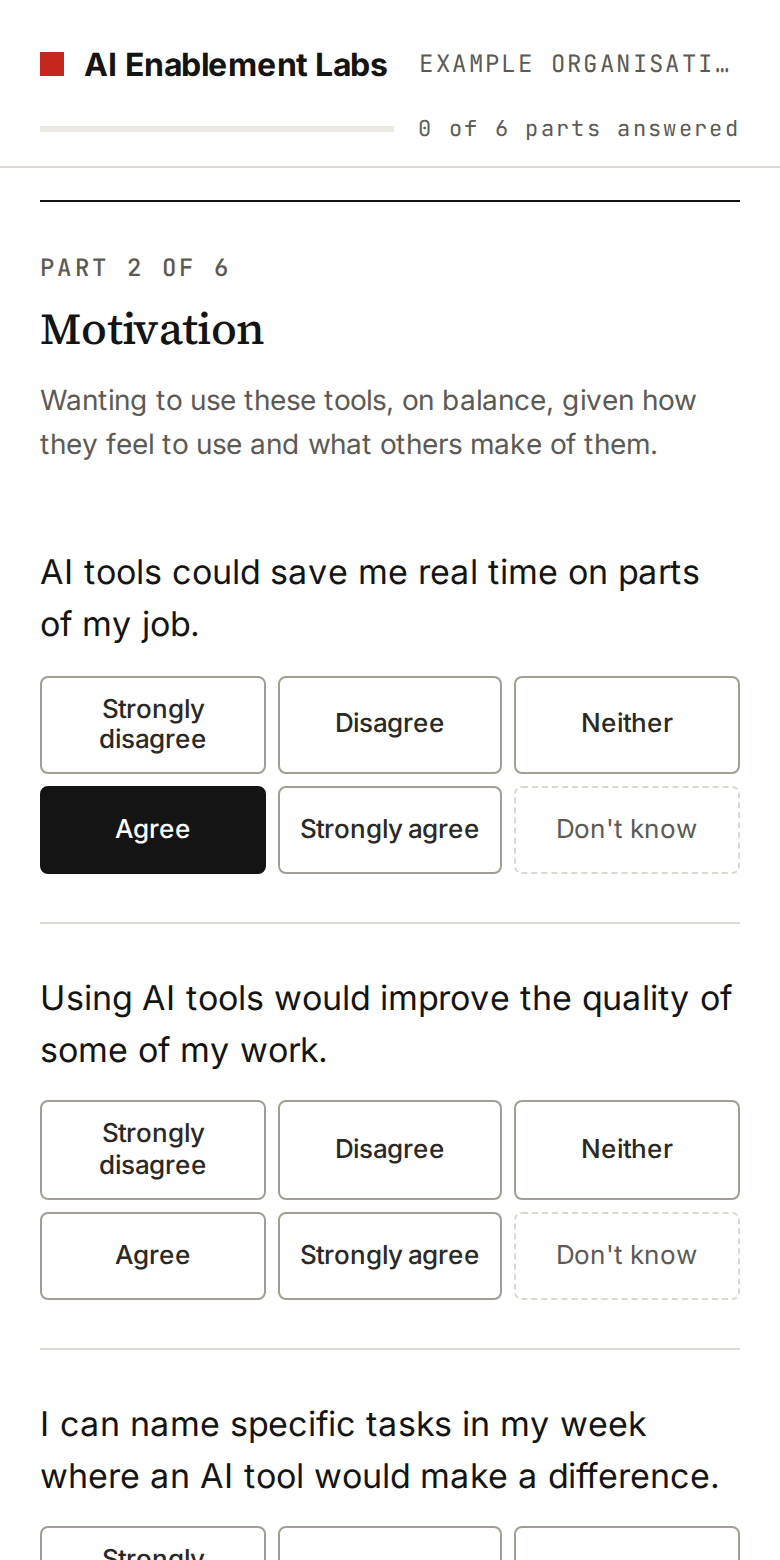
AI-MARS goes to every member of staff through one link.
Read more
No respondent needs an account, and AI-MARS (in 6 parts) takes each person about 18 minutes to complete.
-
Included
The profile by business area
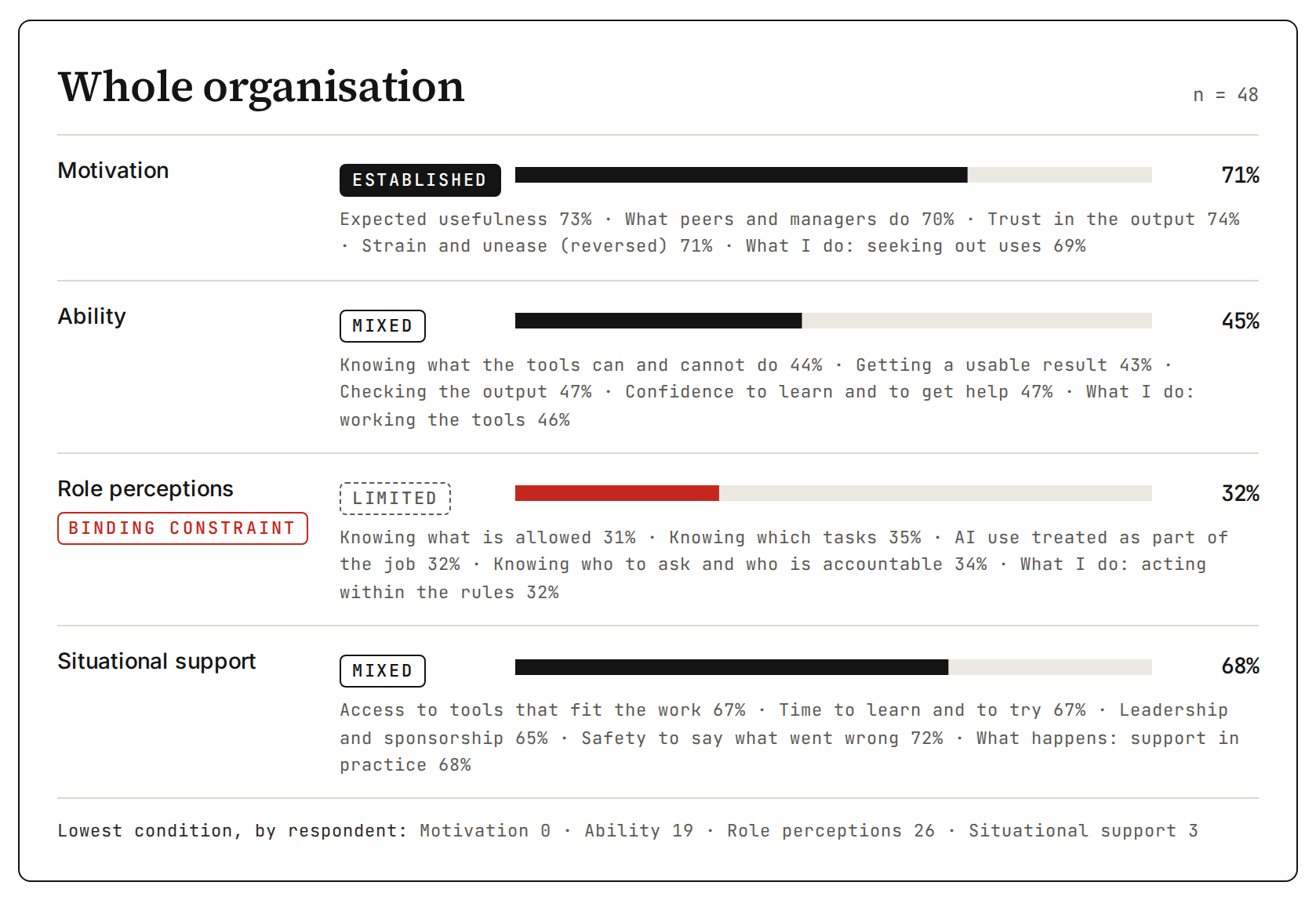
The profile scores the four conditions for each business area the administrator names, and marks the binding constraint in each area.
Read more
The four conditions are motivation, ability, role perceptions and situational support, and the sub-condition detail is shown beneath each condition. An area with fewer than 5 responses shows its count and no scores, due to the risk that an individual's answers could be inferred from so few.
-
Included
The report and the comparison
The organisation's profile is read against every organisation measured so far (the comparison set), with the n stated on every comparison.
Read more
The organisation's report is re-scored against each release of the norms at no charge. The norms are likely to change as the comparison set grows.
What we ask in return
The anonymised responses are pooled, and the organisation is never identified.
- Pooling
- The anonymised responses are pooled with those of other organisations to build the comparison set, and to test AI-MARS itself (its reliability, its factor structure and, later, its predictive models). This use is stated in our agreement from the start, however your organisation is not identified by anything in another organisation's report.
- A census, not a sample
- The link goes to everyone in the organisation, due to the fact that a census removes sampling error from the first results. As such, every business area receives a figure with its n stated.
- A second round later
- A second round is requested from each founding organisation (about a year after the first census). The second round shows what has changed in each business area since the first census. A second round uses founding places while any remain, and is priced once the places are taken.
Ask us to set it up
We will set up the census and read the results back.
One of the founders can set up the business areas, provide the wording of the announcement and read the profile back in a session. An organisation that prefers this set-up can ask for it with the form below.
What the set-up and the read-back cost
The set-up and the read-back cost nothing for a founding organisation.
An organisation can also email sales@aielabs.co.uk, or ask for a scoping call first.
What happens next
Once the form is sent, the census runs in four steps, from the reply to the read-back.
-
We reply with dates
We will reply within one working day with the dates on which the census can run. Our agreement will come with that reply (this agreement sets out the anonymity rules and the pooling of the anonymised responses).
-
Name the areas
Your administrator will name the business areas (for example finance and customer service) and tell the staff that the census is coming, and we will provide the wording of the announcement.
-
Send the link
Most organisations of about 60 people complete the census within two weeks of the link going out. The profile updates as responses arrive.
-
Read it back
One of the founders will read the profile back to the organisation area by area – with the sub-condition detail, and the remedy that follows from the binding constraint in each business area. Two business areas of the same organisation will often need two different remedies.