AI-MARS · the instrument
AI-MARS names the condition that limits how well the people in each business area use AI.
AI-MARS reports four scores for each business area and no total score, and marks the lowest of the four as the binding constraint.
What AI-MARS scores
Whether a person uses the AI tools at work depends on four conditions – whether the person wants to use the tools, is able to, believes the work is part of the job and is allowed, and has what is needed (licences, time and a sponsor).
AI-MARS scores these four conditions (motivation, ability, role perceptions and situational support) for every business area in the organisation, and names the condition that limits each business area. AI-MARS also shows how the organisation compares with the organisations measured so far.
What AI-MARS isAI-MARS is a questionnaire that scores four conditions for AI use at work (through twenty sub-conditions) for every business area of an organisation. AI-MARS also includes the comparison set against which each score is read.

The four conditions
Performance needs all four conditions to be present.
The four conditions come from the MARS model of individual behaviour (McShane and Von Glinow, 2010).
Why the MARS model
The MARS model is used in our instrument because it sorts the evidence on technology adoption into categories that bear directly on performance, and because each of the four conditions has a different remedy.

Motivation
Do I want to?
Motivation covers performance expectancy, social influence, output trust and technostress, and records exploratory use. What peers did was the largest predictor of intention to use the tools in the strongest employee study, and the only factor with a significant indirect path to actual use.
When it bindsusefulness demonstrated on the person's own tasks

Ability
Can I?
The ability condition covers AI literacy, ease of use and self-efficacy. Knowledge was named as the primary barrier by every participant in a study of small firms, and curiosity on its own did not predict knowledge.
When it bindsstructured training on the critical tasks, then practice on real work

Role perceptions
Is it my job, and am I allowed?
Role perceptions cover whether AI use is part of the role, on which tasks and under which rules. Role perceptions are scarcely measured in the adoption literature. Use of AI tools on a personal account usually suggests that the rules are unclear to the person using them.
When it bindsthe policy and rules restated for the role, with the approval loop in the workflow

Situational support
Do I have what I need?
Situational support covers licences, time, infrastructure, leadership cover, and a climate in which it is safe to try the tools and to say what went wrong. These supports matter only where they bind. As such, the effects of these supports appear inconsistent across studies.
When it bindslicences, time released by the line manager, and a named sponsor
The twenty sub-conditions
Each condition is measured through five sub-conditions of four items, and one of the five asks what the person does.
A condition score says which of the four is lowest. A sub-condition score says which part of that condition is low, and thus which remedy is likely to work – a low motivation score driven by strain calls for a different response from a low motivation score driven by what peers do.
How the sub-conditions are built
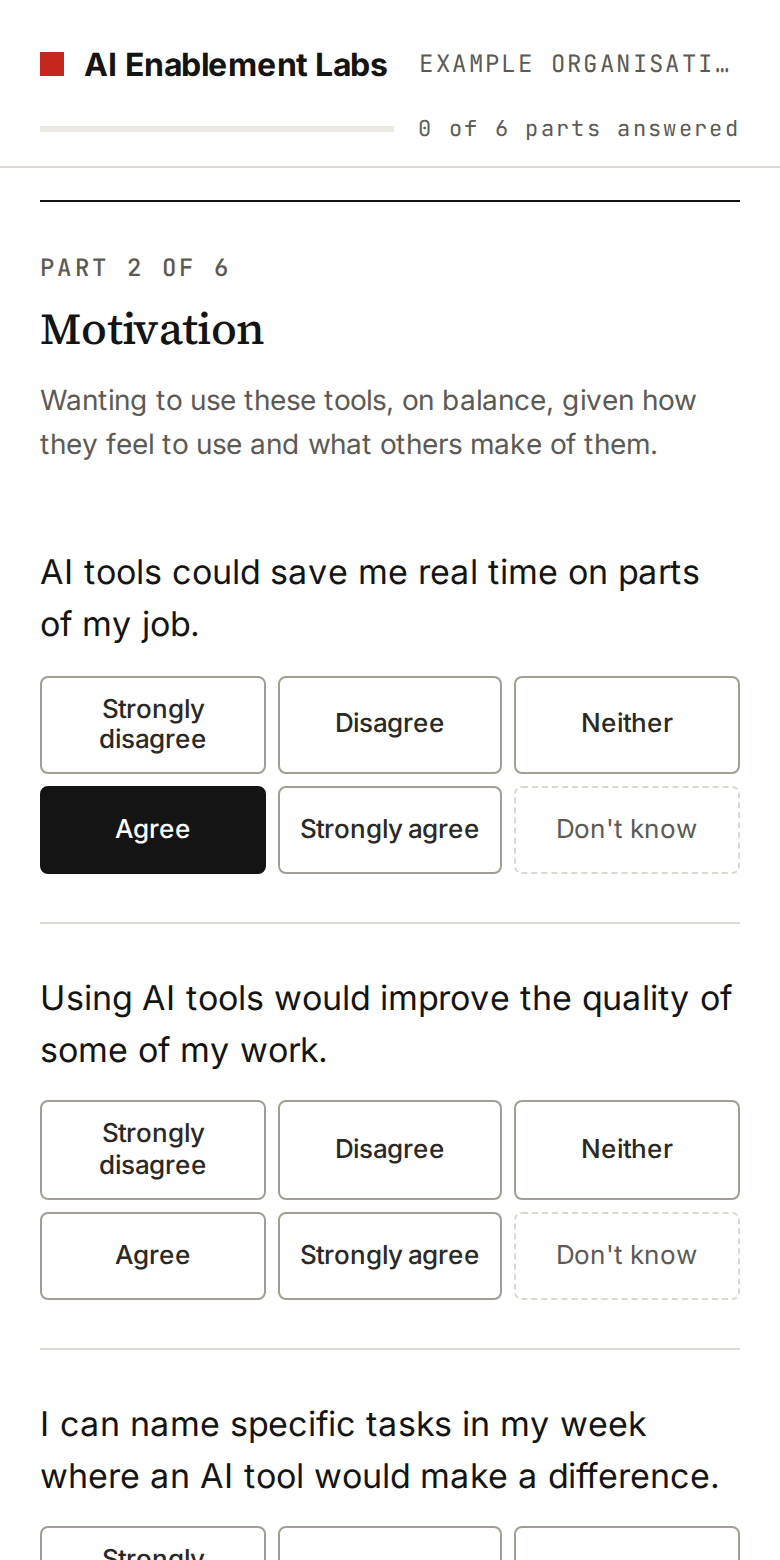
Version 0.2 has 80 scored items (20 sub-conditions of 4 items), of which 27 are anchor items retained verbatim from version 0.1. Four of the five sub-conditions in each condition ask what a person believes, knows, feels or has. The fifth sub-condition asks what the person has actually done (tried a tool unasked, reworked a request, checked the rules, been given time), due to the fact that reported behaviour predicts later use better than stated intention does. Every scored item is answered on a five-point agreement scale with a "don't know" option, and "don't know" is scored as missing.
| Condition | Sub-condition 1 | Sub-condition 2 | Sub-condition 3 | Sub-condition 4 | Sub-condition 5 · what I do |
|---|---|---|---|---|---|
| Motivation Do I want to? | Performance expectancy | Social influence | Output trust | Technostress (reversed) | Exploratory use |
| Ability Can I? | AI literacy | Use self-efficacy | Output verification | Learning self-efficacy | Practised use |
| Role perceptions Is it my job, and am I allowed? | Policy clarity | Task-scope clarity | Role expectation | Accountability clarity | Compliant use |
| Situational support Do I have what I need? | Tool access | Time availability | Leadership support | Psychological safety | Enacted support |
Alongside the scored items, the questionnaire records what people actually do (which tools, how often, on how many kinds of task, and whether AI-assisted work reached anyone) – the behaviour the four conditions are meant to predict.
The binding constraint
AI-MARS reports four scores and no total score.
The lowest-scoring condition in a team (the binding constraint) is the condition that limits that team most, and every condition below the target limits it.
Why there is no total
The MARS model treats the four conditions as jointly necessary, and a strong condition does not make up for a weak one. A total score would let a high motivation score hide a missing licence (a gap in situational support). Thus, each condition is scored separately in our report, and the lowest is treated as the binding constraint. The remedy depends on which of the four conditions is the binding constraint.
How a score is read
A score is the rescaled mean for a condition, and is read against a target level.
The score runs from 0 to 100 and is reported for each condition and each sub-condition, for each business area.
How the score and the target are set
The score for a condition is the mean of its items on the 1 to 5 scale (reversed items reversed first), rescaled to 0 to 100. A group's score is the mean of its respondents' scores. The same is done for each sub-condition. "Don't know" is left out of the mean and reported as its own count.
A reading against a target level for that condition or sub-condition is printed beside each score in our report. The target level is set by expert judgement against the published evidence (a criterion-referenced approach, in the classical tradition), and every report states the target it was read against. The target level is set at 70 as a first setting, and the cut points will be revised with each release of the instrument as the expert review proceeds.
An empirical comparison against the organisations measured will be added once the comparison set exists. The comparison will be shown beside the target level, not in place of it, because where an organisation stands among others and whether it has reached a level at which use is likely to follow are two different questions. Once the behaviour and outcome items give us a criterion (which tools people use, how often, and whether AI-assisted work reaches anyone), the targets can move to empirically derived levels, set by standard setting against that criterion (following Kane, the method used on the national early-learning measure).
| Band | Score (0 to 100) | Reading against the target |
|---|---|---|
| Established | 70 or more | At or above the target level. The condition is unlikely to be what limits use in this group. |
| Mixed | 40 to 69 | Below the target level. The condition is present in part, and the sub-condition detail says where it is weakest. |
| Limited | Under 40 | Well below the target level. The condition is largely absent in this group and is a likely limit on use. |
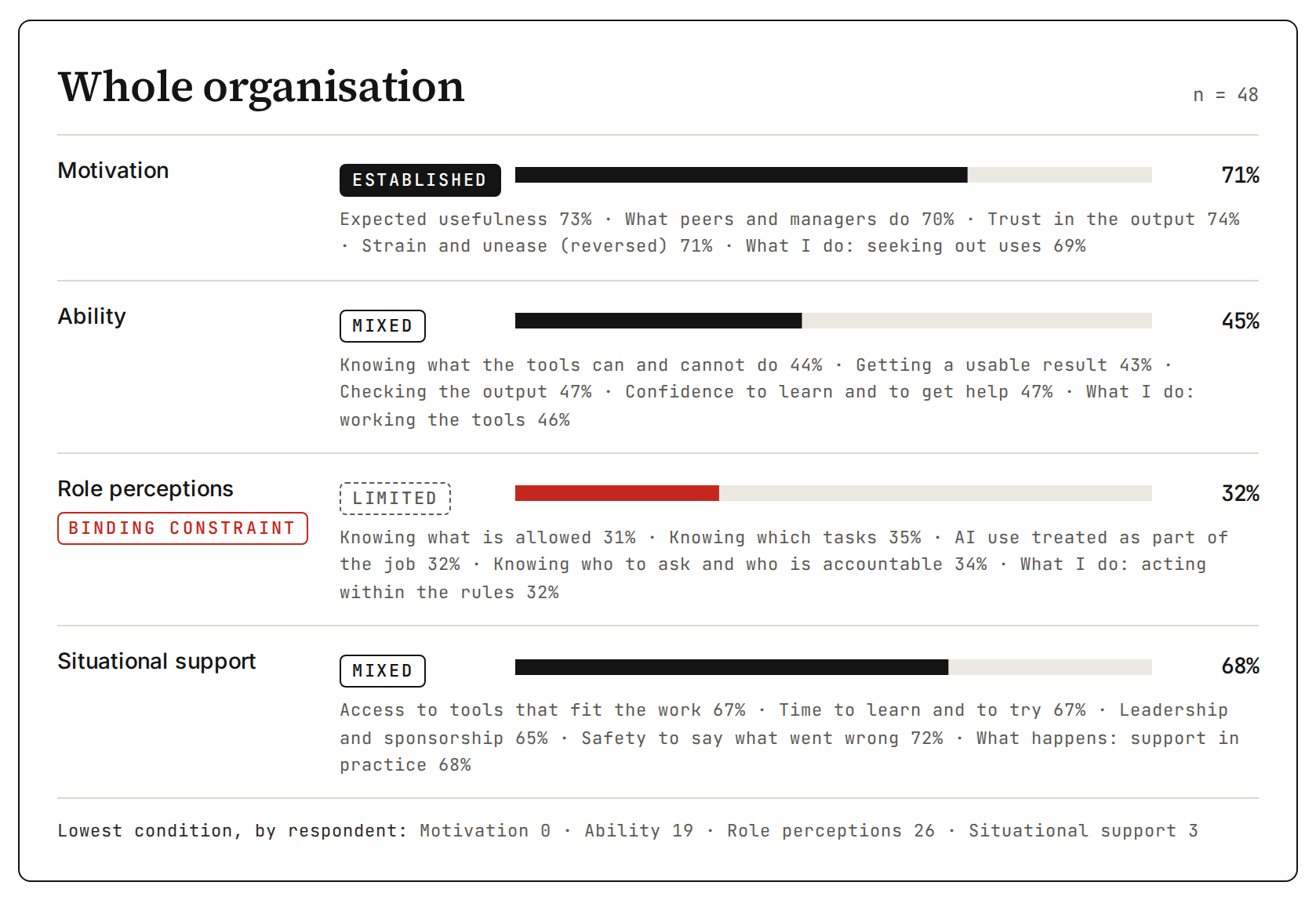
The binding constraint in a business area is the condition with the lowest score. Every condition below the target level limits that area, and the binding constraint is the one to act on first.
What you receive
The organisation receives a profile for every business area, and the comparison behind each profile.
- The profile
- Four condition scores for the organisation and for each business area the administrator defines, with the number of responses (n) behind every figure.
- The binding constraint and its remedy
- Which condition limits each business area, and the remedy that follows from it – usefulness demonstrated on the person's own tasks, training, the policy and rules restated for the role, or licences, time and a sponsor. The four remedies are described under Training and Development.
- The comparison
- How the organisation's profile compares with the organisations measured to date, with the n stated on every comparison. A comparison across eight organisations is not an estimate of a population, and the comparison figure states this. Each score is read against its target level, and no comparison is shown, until enough organisations have been measured.
- Re-scoring as the comparison set grows
- Every organisation that joins enlarges the comparison set. Every past report is re-scored against each release of the norms, at no charge, once the first release of the norms is published. As such, a profile from year one will be compared with more organisations in year two.
- Anonymity
- Each respondent gives a business area and nothing else. The organisation receives results by business area, and never an individual's return. An area with fewer than 5 responses shows its count and no scores, due to the risk that an individual's answers could be inferred from so few.
How it runs
Each person answers from one link in about 18 minutes, and results are reported by business area.
Administrator seats cost nothing and are unlimited in number. AI-MARS goes to the whole organisation at once (a census, not a sample).
Why a census
In an organisation of 60 people, a census leaves no sampling error in the first results.
-
Create the account
The administrator gives their name, the name of the organisation and its size band. There is nothing to install, and nothing to pay for the account.
-
Name the business areas
The administrator names the business areas in which the organisation can act on the results (for example customer service, contracting, finance or the warehouse). Each respondent picks one.
-
Send one link
The census is distributed through one link and a QR code for the whole organisation, or through a personal link for each person. Respondents do not need accounts.
-
Read the profile
Your profile updates as responses arrive and names the binding constraint in each business area. A second round a year later will show what has changed since the first census.
The portal runs AI-MARS version 0.2, and every report states the version it was scored on. Create an account →
The evidence standard
AI-MARS measures what people have done with the tools, alongside what they intend to do.
Roughly two thirds of the studies behind today's AI-readiness assessments measured intention to use and nothing else. Intention usually predicted use where both intention and use were measured, however in one study intention did not predict use.
- AI-MARS asks what people do and what they produce (which tools they use on which tasks, the checks they run, and the work that results).
- Psychological safety appears in none of the studies we reviewed, however situational support includes the item: if I tried an AI tool on a task and it went badly, I could say so here without it counting against me.
- The four conditions are a published organising framework, and have not yet been validated as a causal model.
The versions of the instrument
Version 0.1 of AI-MARS (27 items across the four conditions) was drafted in August 2026 against a commissioned review of the research on AI adoption at work (a review that began with about 300 papers). Version 0.2 widens each condition to five sub-conditions of four items (80 scored items), retains all 27 items of version 0.1 as anchors, and adds the behaviour items that a predictive model needs. Expert review of version 0.2 is in progress.
The terms we use
What the terms mean.
- The four conditions
- What a person needs before they will use a tool – wanting to (motivation), being able to (ability), knowing the work is part of the job and is allowed (role perceptions), and having the licence, time and cover (situational support).
- The binding constraint
- The lowest of the four conditions in a business area. The binding constraint is addressed first. The lowest condition is the one most likely to be limiting use where the four conditions are jointly necessary.
- Business area
- The unit the organisation acts on (a team, a department or a site). The administrator names the business areas, each respondent picks one, and results are reported for each business area.
- Census
- Sending the questionnaire to everyone in the organisation, not to a sample. A sample would leave too few answers per business area in an organisation of 60 people. Thus, the questionnaire goes to everyone.
- Round
- One run of the questionnaire. A second round a year later shows what has changed.
- The comparison set
- The anonymised results of every organisation measured so far. Your profile is read against the comparison set.
Next step
The first census comes before any remedy.
The administrator creates the account, adds the business areas and sends the link. Where an organisation wants to talk first, we reply within one working day.
You can also email sales@aielabs.co.uk.